
One editor, a help centre, and a link under every claim
This is a guide to a service run by somebody else. Knowing who wrote it and what it earns is the first thing you should be able to find out.
Corrections go to the address in the footer. Anything about your own order has to go to the operator, which is the only party that can see it.
In this guide
Where this site stops
The picture is the operator front page, and it is where this site ends. Every page here describes what happens on the other side of that screen, and not one of them can reach across it. No account here holds your money, no page here sees your order, and nothing written here can move a parcel by a single day.
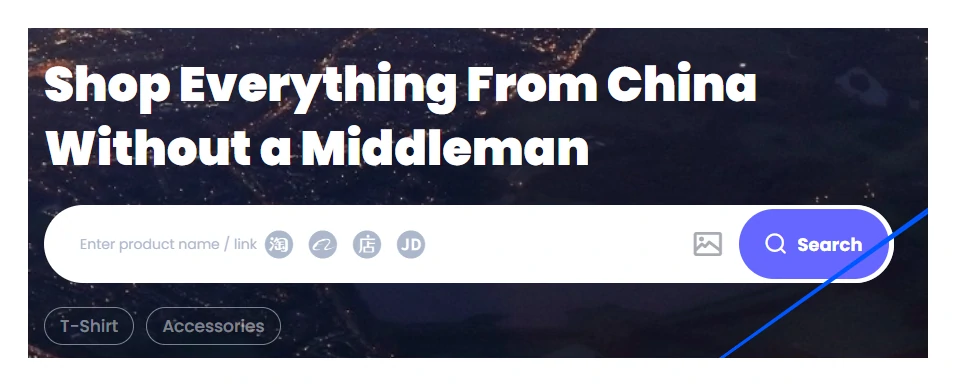
That boundary is worth stating early because a great many guides in this category blur it, writing in the first person plural about a warehouse they have never been inside. This one is written by a single editor who reads the published help centre, opens every screen it describes, and writes down what it says, including the parts where two articles disagree. Where a claim appears, the article it came from is linked from the sentence that makes it.
Who does what, in plain terms
Three parties are involved in a purchase that starts on a browsing site and ends at your door, and they are easy to confuse because all three appear in the same browser session. None of them can do the others job.
| The thing | This site | PonyBuy |
|---|---|---|
| Showing you products | Links out to a catalogue. Holds no product data of its own | Does not show products. It buys the one you point at |
| Taking your money | Never. There is nothing here to pay for | Twice. Once for the goods, once for the flight |
| Seeing your order | Never. No account here, no order record, no access | All of it, which is why order questions can only go there |
| Handling the goods | Never touches anything physical | Buys, receives, photographs, stores, packs and dispatches |
| Deciding what is worth buying | Explains how to judge a listing. Recommends no seller | States that judging the seller is yours to do |
| Being wrong about a rule | Entirely possible. Corrections go to the editor | Also possible, and it has happened in print more than once |
The last row is not a joke. Several operator articles disagree with each other in ways that change what you would do, and those are collected on the updates page rather than quietly resolved.
How a sales page becomes a sentence here
The method is the same on every page and it is worth showing on a real example, because the interesting part is what gets thrown away.
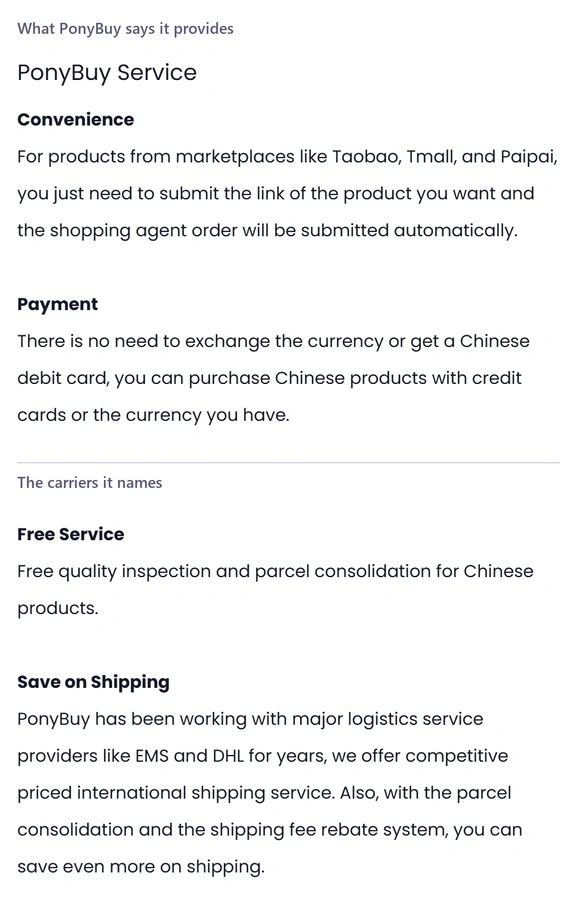
The panels in the picture are the operator describing its own service. Four headings, all positive. Two of them survive into this site as statements of fact, because they contain something checkable: the named logistics partners, and the stated scope of the free inspection. One survives as a qualifier, the part about inspection and consolidation being free for Chinese products, since the qualifier is the whole point. And the rest, the wording about convenience and about working with providers for years, is dropped, because there is nothing in it that could ever be wrong.
That filter is the entire editorial position. Mechanisms and published commitments are written down. Adjectives are not. Anything with a price on it stays upstream. Where the source says something unflattering about itself, and it does in several places, that gets carried across at full strength rather than softened, because those paragraphs are the ones that matter after something has gone wrong. The source panel here is the service description.
How this is paid for, link by link
There is no subscription, no newsletter and nothing to buy here, so the money comes from somewhere else and you are entitled to know exactly where. There are only three kinds of link on this site and two of them earn.
| What you click | Where it takes you | What this site earns |
|---|---|---|
| A product category or a search | The catalogue this site links out to | A commission if a purchase eventually follows |
| A link to a help centre article | The operator own published answer, on its own site | A commission if a purchase eventually follows |
| A link to another page here | Another page on this site | Nothing at all |
| The search box in every page header | A results page in the catalogue | The same commission arrangement as any other catalogue link |
| An email address | Your own mail client, and then one person | Nothing, and there is no list to be added to |
Two consequences follow and both are visible in the writing. Nothing here recommends a seller, because a recommendation that earns is not a recommendation. And the page about choosing an agent names the cases where you should use a different service entirely, including one that removes half the bill. That page is here.
Getting in touch, and what to expect
The vocabulary and the general questions are on the questions page. What follows is about this site itself.
How do I get in touch?
By email, to the address printed in the footer of every page on this site. One person reads it. That is the right route for a correction, a broken link, or something here that has stopped being true. It is the wrong route for anything about your own order, which nobody here can see.
Will you tell me whether a particular seller is any good?
No, because there is no honest way to answer it from here. This site never sees your listing, the goods, or what arrived. Judging a seller is the one part of this process that stays with you, and the operator says so about itself as well. What is on offer here is the machinery around that decision, not the decision.
Does PonyBuy approve of what is written here?
PonyBuy has no say in it. This site is not run by the operator, was not reviewed by it, and includes the places where its help centre contradicts itself, which is not the sort of thing an approved guide carries. The commercial relationship is the affiliate link and nothing else.
Why should I trust a site that earns money when I click?
Trust the links rather than the site. Every rule here is carried with a link to the operator article it came from, so any claim can be checked at the source in one click. That is deliberate, and it is the only meaningful answer to this question. A guide that cannot be checked is asking you to take its word for it.