
When the box is already on its way to the warehouse
Forwarding is the other half of the business and it barely gets mentioned. You buy from the seller yourself, the box goes to the warehouse, and only the flight is bought here.
If PonyBuy is doing the buying instead, the process starts at turning a link into an order.
In this guide
- What forwarding is, and who it is built for
- Forwarding against buying through the agent
- What the warehouse does with a box you sent it
- The seven situations with no compensation attached
- The one field that decides how smoothly this goes
- After stock in, it stops being a special case
- Four questions before you give out the address
What forwarding is, and who it is built for
PonyBuy names three situations, and they are more varied than the usual picture of this business. A Chinese merchant shipping to overseas customers. Someone inside China sending things to family abroad. And an overseas buyer who already ordered from Taobao or Weidian directly and now needs the box to leave the country. All three end up at the same warehouse address.
The entry point is a link in the navigation bar, and the first thing it does is put a statement in front of you. You cannot reach the form until you have ticked the box saying you read it, which is the one screen on this whole journey that people click through fastest and should not.
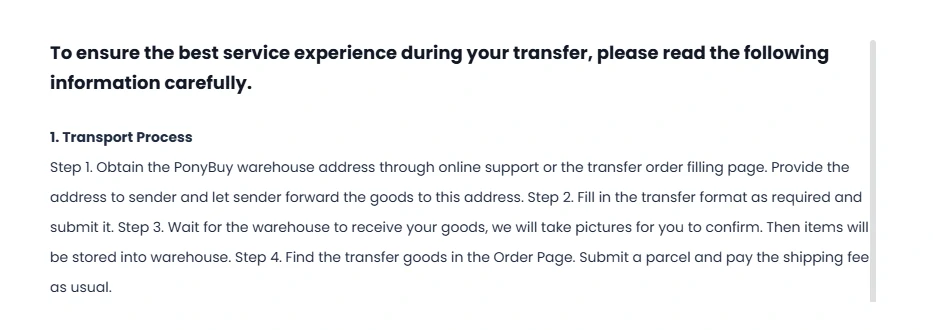
The four steps in that panel are the entire mechanism. Get the warehouse address and pass it to the sender. Fill in the forwarding form. Wait for the warehouse to receive the goods and photograph them for you to confirm. Then find them on the order page and submit a parcel exactly as you would for anything bought through the agent. Only the first half is different. From stock in onwards the two services are the same service.
Forwarding against buying through the agent
PonyBuy publishes a comparison of its own two services, which is unusual and useful. The difference that matters is not the price of the flight. It is who deals with the Chinese seller.
| Buying through the agent | Forwarding a parcel | |
|---|---|---|
| Who buys the item | PonyBuy buys it for you after you pay | You do, or whoever is sending it to you |
| What the total is made of | The item, the Chinese delivery, the international leg, the clearance | The international leg and the clearance, and nothing else |
| What you need before you start | An account here and a card | A Chinese platform account and a way to pay the seller |
| Where the item description comes from | The link you submitted | You type it, or use the button that pulls it in for you |
| Is the item inspected | Yes. Inspection is part of the flow | Only if you select the inspection option when you submit |
| Who it suits | Anyone without a Taobao or Alipay account | Frequent shoppers, gifts from relatives, and anything not bought online |
One line at the end of that article is easy to miss and worth having. Once two different kinds of goods are stocked, you can consolidate them into one parcel or ship them separately, provided the weight limit and the requirements of the route are met. Bought and forwarded goods do not live in separate warehouses. The comparison article has the rest.
What the warehouse does with a box you sent it
Every forwarded parcel is opened. That is stated rather than implied, and the reasons are checking for forbidden items and weighing. What follows is a list of things the service does not include, and it is the most important paragraph on the forwarding pages.
It does not inventory or classify your goods. You classify them yourself when you fill in the form, and each commodity you add there counts as one order record. If something is missing when the box is opened, PonyBuy says to take it up with the sender and that it is not responsible for losses it did not cause. Specialist products get no specialist inspection. And it states directly that it provides no after sales service for forwarded goods.
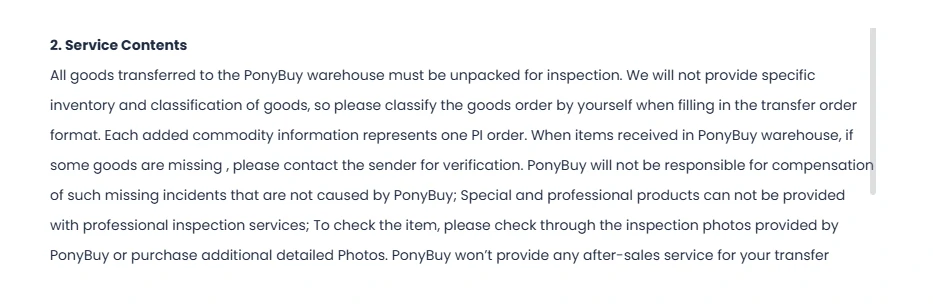
The optional inspection is narrower than it sounds, and the agreement spells out the limits. Selecting it authorises checking quantity, colour and size. After that the original courier box is thrown away and the goods are resealed in the operator own packaging, except for fragile items, very large ones, and items where the courier box is the packaging. Slight colour differences and size errors are excluded by name. Electronics and accessories are not checked for quality, model or contents. Discs and figures keep their plastic on, and only the outside is looked at.
What that leaves you is the photographs. Those, or a paid set of detailed ones, are the only way to see what actually turned up, which makes the photographs worth more here than on an order the agent placed itself. The forwarding agreement is long, and worth ten minutes.
The seven situations with no compensation attached
The agreement lists them plainly, and none of them is unusual for this kind of service. The value of reading them is that each one points at the thing that would actually have protected you.
| The situation as published | Is there compensation | What would have helped |
|---|---|---|
| Damage in circumstances outside its control | No, and insured parcels are the stated exception | Insurance, bought at the point of submission |
| Goods held or dealt with under the law for breaking shipping rules | No | Reading the forbidden list before the box is sent |
| A parcel that left sealed, untampered, at full weight and complete | No. This is the clause that surprises people | Nothing on this side. The claim belongs with the carrier |
| Loss or delay caused by you or by the goods themselves | No | An accurate description and adequate packing at the sending end |
| A claim raised after the enquiry period closed | No | Raising it while the window is open, counted from submission |
| A parcel detained or destroyed under the laws of your country | No | Route choice, and not sending what your country will not admit |
| Indirect losses, or profit you did not make | No, stated separately from the rest | Nothing. This category is excluded outright |
The forbidden lists in that same agreement run to three sets, one general, one following postal practice, and one specific to Taiwan. They are worth a skim rather than a read, because the general shape is predictable and the specifics are not.
The one field that decides how smoothly this goes
You get the warehouse address from the forwarding page, pass it to the sender, and ask for the courier number. Then you type that number into the form. PonyBuy is unusually direct about why this matters: an accurate number lets it match the arriving box to your product information without coming back to you, and a wrong one turns into a delay plus a conversation.
The counting rule sits behind the same field. Every courier number you add becomes its own order record, so three boxes from three sellers are three records even though they are one forwarding submission. It goes further: if one courier package holds a lot of items, or large ones, the team photographs and stores them separately and several records come out of the one box.
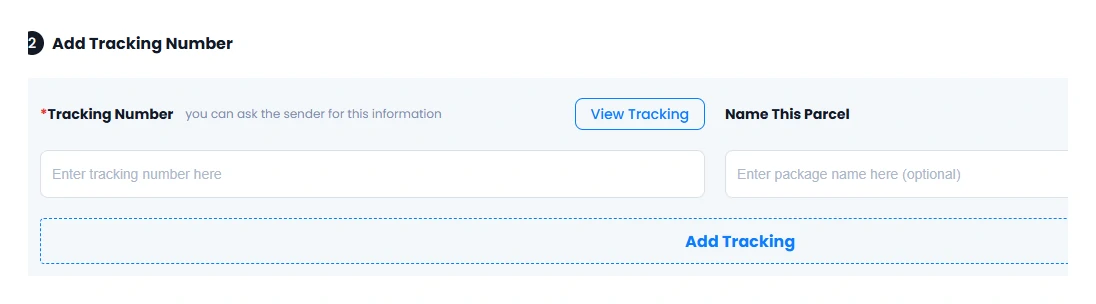
Fill the optional name field. It costs nothing and it is the only thing that will tell two identical rows apart on the parcels page in three weeks. Once every number is in, submitting generates the forwarding order identifier, which is what you follow from then on.
After stock in, it stops being a special case
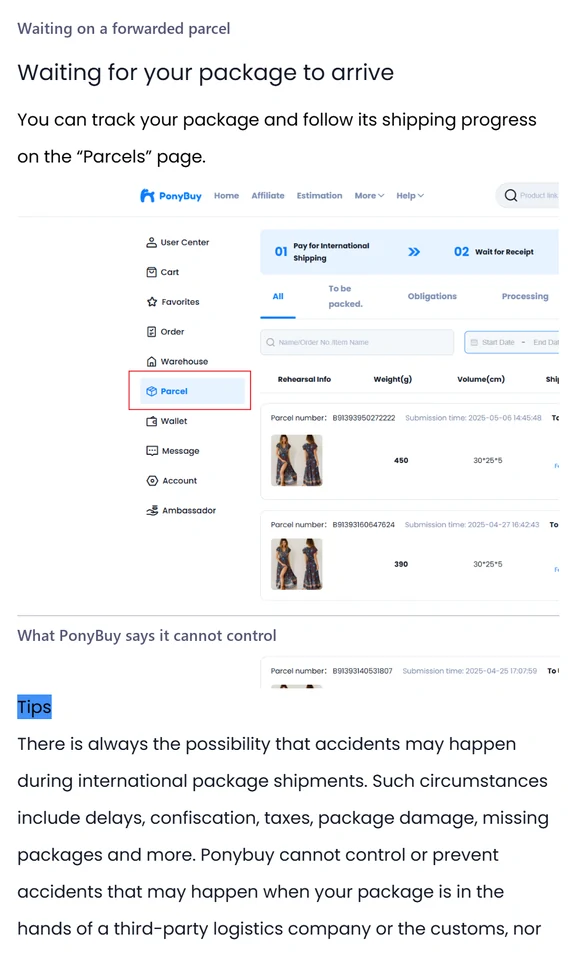
Once the goods are on a shelf the forwarding part is over. They appear with everything else, you submit a parcel, you choose a route, and you pay for the international leg. The Parcels page is where the result lives, with the weight and the volume the warehouse measured sitting next to each submission.
Two things are worth knowing before that point. The first is the arrival window. PonyBuy publishes a normal transit time for the domestic Chinese leg and says that if the warehouse has not signed for the box after it, you chase your own courier or its online support, not the order page. The agreement also names the warehouse city, and it is the same disagreement recorded on the timing page, where two published articles give two different cities.
The second is the warning it attaches to the Parcels page. Delays, confiscation, taxes, damage and missing parcels can happen once a box is with a third party carrier or with customs. PonyBuy says it cannot control or prevent them. That sentence applies to every parcel, and it is printed where you are most likely to be refreshing.
Four questions before you give out the address
What happens to the box once it is on a shelf is on the warehouse page. The rest of the common questions are on the questions page.
Can I send things to the warehouse that I bought myself?
Yes, and PonyBuy treats it as a separate service rather than a favour. It names three cases for it: a Chinese merchant shipping to overseas customers, someone in China sending to family abroad, and an overseas buyer who ordered from a Chinese platform directly. You get the warehouse address from the forwarding page and give it to whoever is sending.
Is forwarding cheaper than having PonyBuy buy it for me?
It removes one line rather than making the shipping cheaper. PonyBuy sets out both totals plainly: a shopping agent order is the item plus the Chinese delivery plus the international leg plus clearance, and a forwarding order is the international leg plus clearance only, because you already paid the seller yourself. The flight costs the same either way.
Three items are coming in one box. Is that one forwarding order?
Not necessarily. PonyBuy counts order identifiers by courier tracking number, so one number is one identifier. But it also says that where a single courier package holds many items or large ones, the team photographs and stores them separately, and you end up with several identifiers from one box.
The warehouse never signed for my parcel. Who do I chase?
Your own courier first. PonyBuy publishes a normal arrival window for domestic Chinese delivery and says that if the warehouse has not signed after it, you should check with the domestic logistics provider or with its online support. The parcel is not in its system until it is signed for, so it cannot see anything you cannot.