
The words on these screens, and who can answer what
Half of the confusion in this process is vocabulary. The other half is not knowing which of three inboxes a question belongs in.
Questions tied to one stage sit on that stage page. What is collected here is the vocabulary, the questions that span the whole journey, and the contact routes.
In this guide
A glossary of the words you will meet
Some of these are operator vocabulary, some are shopper shorthand, and telling them apart matters. A word used in a community chat will not be recognised by support, and a word on the order screen means something precise.
| The word | What it means here | Where you run into it |
|---|---|---|
| Spreadsheet | A browsing site that lists products as cards you open one at a time | The name of this whole kind of site, including this one |
| QC | Quality control, and in practice the photographs taken when an item lands | Your order, once the status has moved past Received |
| GL and RL | Shopper shorthand for green light and red light, cleared to fly or not | Community chat. The PonyBuy word for the red one is a mailing restriction |
| W to C | Where to cop, which is a request for the link to something in a photograph | Anywhere shoppers post pictures without saying where they came from |
| Haul | One shipment holding several purchases made at different times | What these pages call a batch, and what the warehouse calls a parcel |
| Received and Stored | Two different things. Arrived in the building, and shelved and selectable | The order list, usually about a working day apart |
| Volumetric weight | Size charged as though it were weight, because aircraft sell space | The parcel row, printed next to the weight that a scale measured |
| Declared value | The figure that goes on the customs paperwork for the box | The submission form, as a choice you make rather than one made for you |
| Separate packaging | A label the system applies by itself when one side of an item is long enough | Your warehouse page, refusing to put everything in one parcel |
| BT | Beijing time. Every published processing window is measured in it | The service table, where it appears in brackets and is never explained |
| Operation fee | The up front charge on the offline route, taken before any freight is quoted | Customized Shipping, which never appears in the normal route list |
The last row but one is the one that causes real trouble. An order you placed in your evening is being measured against a working day that has not started yet, which is why nothing has happened by the time you wake up. The service standards article is where those windows are published.
What to include when you ask for help
A support message that arrives with everything attached is answered once. One that arrives as a sentence turns into three days of back and forth, and the difference is entirely in what you put in the first message.
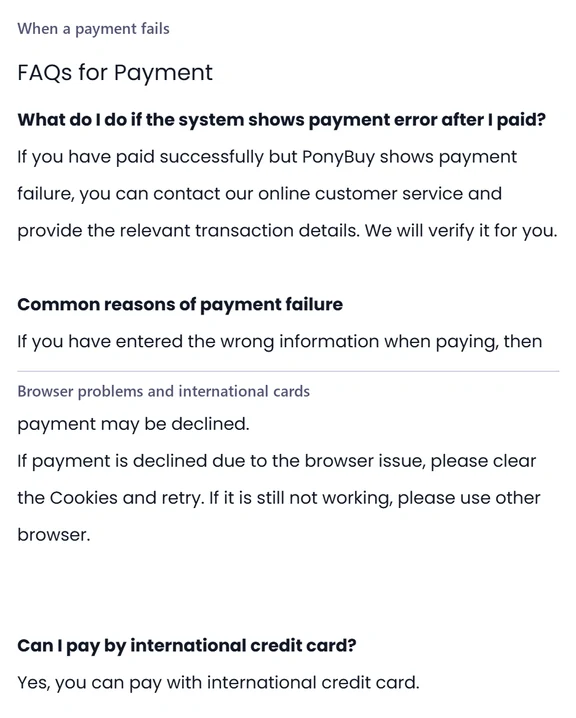
The payment troubleshooting article is the clearest example of this, because it does not say contact support. It says contact support with the transaction details, so that the payment can be verified. That is a specific instruction about the contents of your message, and it is there because the alternative, paying a second time, produces two orders and one item.
The same shape applies everywhere else. An order question needs the order number. A photograph question needs the item number if the item is already stored. A damage claim needs photographs and the invoice, inside two business days, with the original packaging kept. None of that is bureaucracy. Each one is the thing without which nobody can act on your behalf. The article itself takes a minute to read.
Frequently asked, across the whole journey
These are the ones that do not belong to any single stage. Anything tied to one step is answered on that step page instead, where the screenshots are.
How many times do I pay, and what for?
Twice, and the two payments are months apart in the worst case. The first pays the seller for the goods plus the Chinese domestic delivery that brings them to the warehouse. The second pays for the flight, and it cannot be calculated until the warehouse has packed and weighed the box. PonyBuy describes the service as two steps and two payments in the article it puts in front of new users.
Do I need a Chinese bank account, or Alipay?
No, and that is most of what an agent is for. PonyBuy states that there is no need to exchange currency or hold a Chinese debit card, and that you can pay with a credit card in the currency you already have. If you do hold a Chinese account, the forwarding service exists precisely so you can buy for yourself and pay only for the flight.
How long will things sit in the warehouse before I have to ship them?
Ninety days, as published in the first timer article. That window is the whole reason consolidating several purchases into one box is possible, because items bought weeks apart can wait for each other. Past it the status turns to Expired and the item stops being yours, and an extension is only available inside a defined band near the end.
Nobody has touched my order. Is it stuck?
Check the clock it is being measured against before assuming so. Every published processing window at PonyBuy is written in Beijing time, which is where most of the confusion starts, and the window for an order placed in the evening runs to the following afternoon rather than to the following morning.
Is this site run by PonyBuy?
No. This is an independent guide written by one editor, and it does not hold your money, place your order or touch your parcel. Everything it describes was read in the PonyBuy help centre and is carried with a link back to the article it came from. Links to PonyBuy and to the product catalogue are affiliate links.
The article that answers half of this before you ask
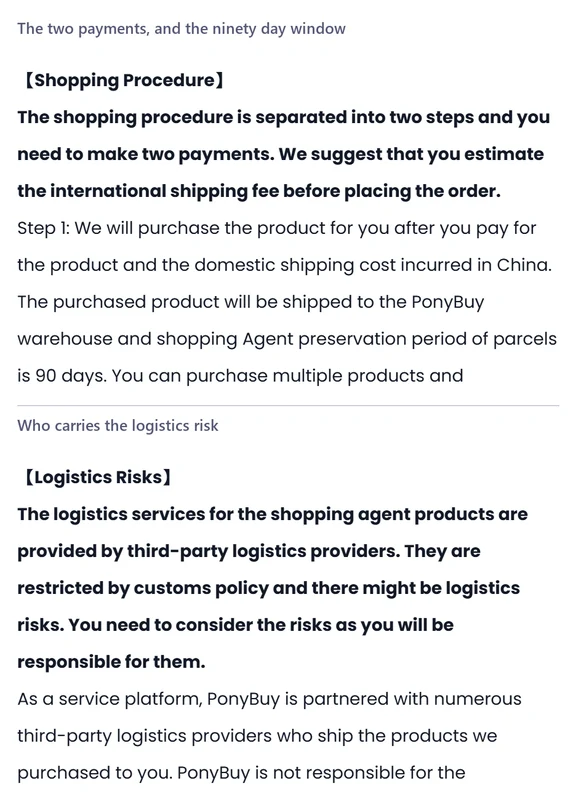
PonyBuy puts a short piece in front of new users, and a surprising share of the questions people send were already answered in it. It is worth reading not because it is friendly, which it is not, but because it is the one place the operator writes down where its responsibility stops.
Two of its three sections carry the weight. One sets out the shopping procedure as two steps and two payments and names the storage window, which is the answer to the third question on this page. The other sets out the logistics risks, and it is blunt: third party carriers, customs policy that nobody controls, and no responsibility accepted for confiscation, damage, loss or delay. It does say it warns about risks in advance and that it is working on insurance.
The third section is a disclaimer about the platforms themselves, and it is the reason the seller is your decision rather than anyone else. Reading the original before the first order is cheaper than reading it after a bad one.
Where to get in touch, and who can actually answer
Three different inboxes exist and they do not overlap. Sending a question to the wrong one is the commonest reason people feel ignored, so this is the one table on the site worth knowing by heart.
| What you need | Where it gets answered | What to have ready |
|---|---|---|
| Anything about an order that exists | The message system inside the platform, attached to that order | The order number. Support cannot search for you by description |
| A payment that left your bank and never arrived | Customer support, by email, before you try again | The transaction reference from your bank |
| A faster answer on an order you are about to place | Speedy Response, which is a paid service rather than an inbox | An understanding that the window depends on when you paid |
| Anything about the offline shipping route | The internal message system, not email | The application you submitted, since the team works from what you typed |
| A question nobody official has answered | The operator community server | Patience. A community is not a support desk and owes you nothing |
| Something wrong on this site | The editor of this site, whose address is in every footer | The page address, and what it says that is wrong |
| Business or partnership | The operator publishes an address for this | Nothing special, although it is the same address as customer support |
The last row is worth flagging rather than smoothing over. PonyBuy lists a customer support address and a business cooperation address and they are the same address, so a commercial message and a broken order land in the same place. The contact page carries both, along with the community server and a registered company address.
Three questions about this site rather than the service
Who writes it, why it has no prices on it, and what to do when it is wrong. The longer version is on the about page.
Why are there no prices or shipping rates anywhere on this site?
Because a rate written here would be wrong within weeks and there would be no way for you to tell. Fees, freight and exchange rates live on the operator side and change without notice. What this site publishes instead is the mechanism, which is what is stable: who charges, when, and what makes the number go up.
A rule here disagrees with what the help centre says. Which is right?
The help centre, always, and the link under every claim on this site exists so you can check. Two published PonyBuy answers sometimes disagree with each other as well, and where that happens these pages put both versions side by side rather than pick one.
Something on this site is wrong or out of date. Who do I tell?
The editor, by email, and the address is in the footer of every page and on the about page. That is the fastest route for anything about this site. It is the wrong route for anything about your order, which only the operator can see.