
Every page here has a date on it, and this is why
Nothing in this business stays true for a year. This page says when the source material was last read and what was different when it was.
The date in the footer of every page is the day the whole operator help centre was read, not the day a file was edited.
In this guide
The one source that moves faster than this site
There is a strip across the top of the operator site carrying whatever is current: a packing offer, a route that opened or closed, a promotion with an end date on it. It is the fastest signal there is that something you read a month ago has stopped being true, and it is not reproduced here.

The reason for leaving it alone is worth stating plainly. An announcement has an expiry date attached to it in the operator context and loses that date the moment it is quoted somewhere else. Repeat one here and this page becomes a museum of offers that ended, presented as though they had not. So the rule on this site is that anything with a clock on it stays upstream, and what gets written down here is the machinery underneath, which changes slowly enough to be worth describing.
The log
One entry so far, which is the honest length for a site that has read its source material once. Entries get added when a rule changes, not on a schedule.
The help centre read end to end, and this site written from it
Every article in the PonyBuy help centre was opened and read, and each page on this site was written from it rather than from a summary. Where an answer exists, it is linked from the sentence that uses it, so that a reader who doubts the claim can reach the source in one click rather than searching for it.
Three things were decided at that point and they shape every page here. No amount of money is printed anywhere, because a fee written down today is wrong within weeks and there is no way for a reader to tell. Where the operator publishes two incompatible answers, both are shown rather than one being picked. And where the operator states plainly that something is not its responsibility, that wording is carried across rather than softened, because those are the paragraphs that matter after something has gone wrong.
The screenshots throughout the site were taken on the same day from the operator help centre and its interface. Where one carries an amount, the caption says so and says whose example figure it is.
What gets re-read first, and why it is always the same pages
Not everything decays at the same rate. Two kinds of claim move often enough that they are the first thing checked on every review, and both live in the same corner of the help centre.
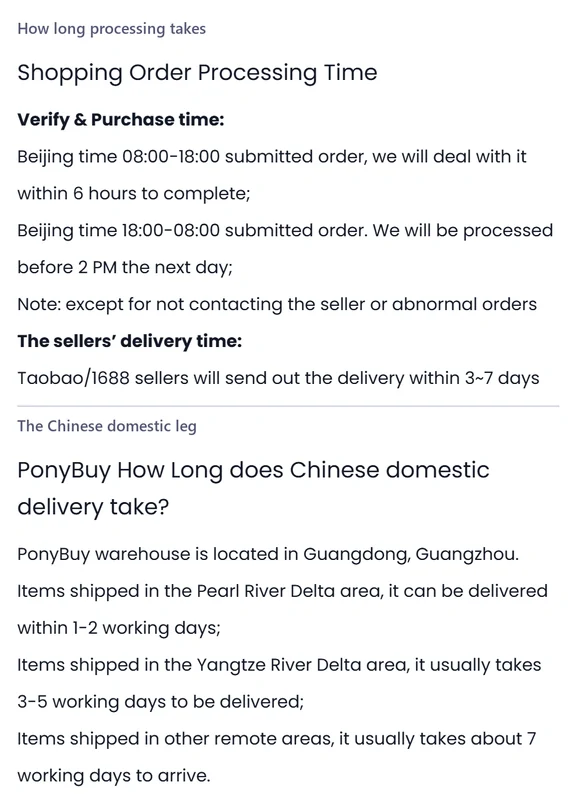
The first is the processing window, because it is the number the operator is most likely to rewrite without saying so. It is also the one already published in two incompatible versions, which makes it the canary: if a third version appears, something upstream has been edited.
The second is the domestic leg, the days it takes a Chinese courier to reach the warehouse. That one moves for reasons nobody controls, and it is tied to the warehouse city, which is itself published inconsistently. Reading those two articles together is how the disagreement on the statuses page was found in the first place, and it is why they are read together every time.
Where the operator disagrees with itself
Five places where two published answers cannot both be right. None of these is hidden, and none of them is a scandal. They are what a help centre looks like after several years of separate people writing separate articles. What matters is that a guide has to decide what to do about each one.
| The question | What is published | What this site does with it |
|---|---|---|
| Where the warehouse actually is | One article says Guangzhou. Two others say Xiamen | Xiamen is used, and the disagreement is named rather than smoothed over |
| How long an order waits to be processed | Two articles give incompatible versions of the same window | Both versions are shown side by side on the statuses page |
| How soon the goods reach you | One article promises receipt within seven working days at the soonest | Not repeated here. No route page anywhere supports that sentence |
| Which carriers actually fly the box | A still reachable article names carriers the current route list does not | Cited as a legacy article, and labelled as one everywhere it appears |
| Whose site you are reading | One article body carries a different company domain in its text | Quoted for what it explains, never for the name printed inside it |
The last row is the reason nothing on this site is quoted from memory. An article that still carries another company name in its body is an article that was inherited rather than written, which tells you something about how carefully to read the rest of it.
How long each kind of claim stays true
Everything on this site falls into one of four buckets, and knowing which bucket a sentence is in tells you how much to trust it a year from now.
- Mechanisms
Mechanisms are the slowest. Two payments rather than one, inspection before storage, a parcel assembled from stored items, a declaration you choose rather than one chosen for you. These are how the business works and they change rarely. Almost everything on this site is deliberately written at this level, which is why it reads as process rather than as advice.
- Published policies
Published policies move in years. Storage windows, compensation exclusions, what an inspection covers, which situations carry no liability. These are the paragraphs the operator writes once and edits occasionally. They are quoted here with a link, and the link is the part that matters, because the quote ages and the link does not.
- Times and thresholds
Times and thresholds move in months. Processing windows, domestic delivery days, weight and size limits for a route. These are checked first on every review for exactly that reason, and they are written as words rather than as figures in a heading so that nothing here can be quoted back as a promise.
- Money
Money moves constantly, so no money appears. Fees, freight, exchange rates, promotions and rebates are all real and all upstream. What this site tells you instead is who charges, at which moment, and what makes the amount go up, which stays true long after any particular number has stopped being.
Three questions about how current this is
Who maintains this and how to correct it is on the about page. The vocabulary and the general questions are on the questions page.
How do I know whether a page here is still accurate?
Look at the date in the footer, which is the day the whole help centre was last read end to end, and then follow the link under whatever claim you are relying on. Every rule on this site carries a link to the article it came from, and that article is the thing that is current. This site is a reading of it, not a copy.
Why is there only one entry in the log?
Because there has only been one review. A guide that launches with a year of back dated entries is telling you something about itself rather than about the operator. This page grows by one entry each time the help centre is read again, and entries are only added when something actually moved.
Does this page track operator promotions and announcements?
No, deliberately. A promotion copied without its expiry date is how a guide quietly starts lying, and the operator strip is the right place to read those because it disappears when they end. What gets recorded here is the slower kind of change, the sort that rewrites a rule rather than a price.