
What every agent does the same, and what actually differs
Four claims appear on every agent home page and three of them describe the Chinese postal system. This page separates the part an agent controls from the part it does not.
This site covers one agent. The comparison here is about what to look for, which works the same whichever name is on the door.
In this guide
Why PonyBuy, and when to use a different agent
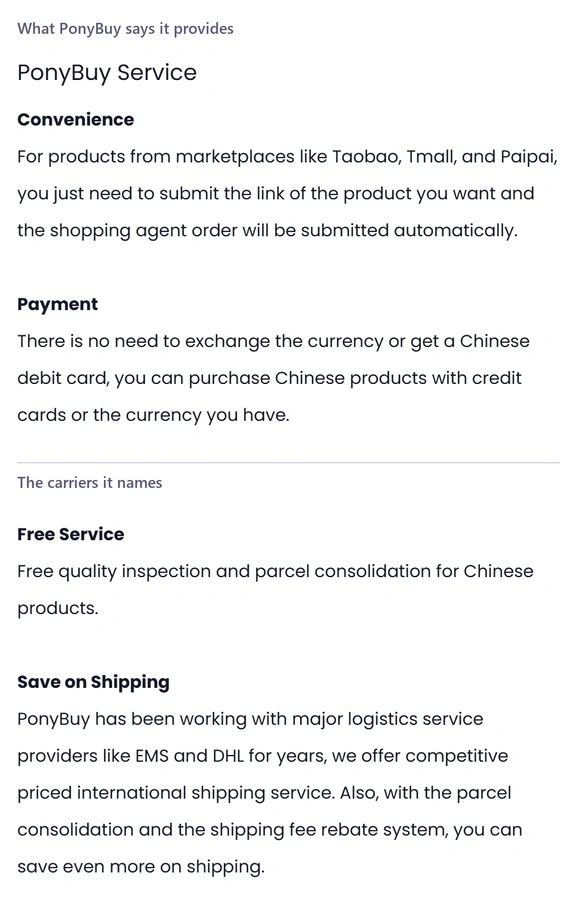
PonyBuy sets out its own pitch in four headings, and they are worth reading because they show how thin most of this category is. Convenience means you paste a link and the order builds itself. Payment means you never need yuan or a Chinese card. Free service means quality inspection and parcel consolidation cost nothing on top, for Chinese products, which is the qualifier worth noticing. Save on shipping rests on long standing work with major logistics providers, which it backs by naming two of them, plus consolidation and a rebate on the shipping fee.
Three of those four are table stakes. Every agent in this business pastes links, takes foreign cards and consolidates boxes. The checkable claims are the ones with a noun in them: the named carriers, the rebate, and the published scope of the free inspection. Those you can compare. Wording about professionalism and care you cannot.
There are cases where this is the wrong service, and they are not hidden. If you already hold a Chinese account and can pay sellers yourself, buying directly and using forwarding removes the purchasing half of the bill. If your goods need specialist inspection, this is explicitly not offered. And if a batch is enormous, the offline logistics route exists but a freight specialist may serve you better. The service description is short enough to read in full before deciding.
What is identical no matter which agent you pick
Most of the journey is not run by the agent at all. Knowing which steps those are makes comparing agents a much shorter job, because the third column is the only one where a choice exists.
| The step | What every agent does | Where one can actually differ |
|---|---|---|
| Buying from the seller | Somebody in China places your order and pays in yuan | How fast, and whether anyone chases a seller who goes quiet |
| Crossing China to the warehouse | A domestic courier carries it | Almost nothing. This is the Chinese postal network |
| Inspection on arrival | Photographs of the outside of the goods | How many photographs, what the scope excludes, what extras cost |
| Storage | A shelf, and a clock running on it | The length of the free window, and the price of extending it |
| The international leg | A third party carrier flies or ships it | Which routes are offered, and the rate the agent negotiated |
| Customs at the other end | Nobody controls this, including the carrier | Declaration options, and whether a route absorbs the tax itself |
Read an agent home page against this table and most of the text lands in column two. That is not dishonesty, it is a young industry describing a shared pipeline. It does mean the differences are smaller than the marketing suggests, and that they sit in specific published numbers rather than in tone.
How to judge an agent from what it publishes
Comparing agents works best as a checklist of six questions, all answerable from public pages without opening an account.
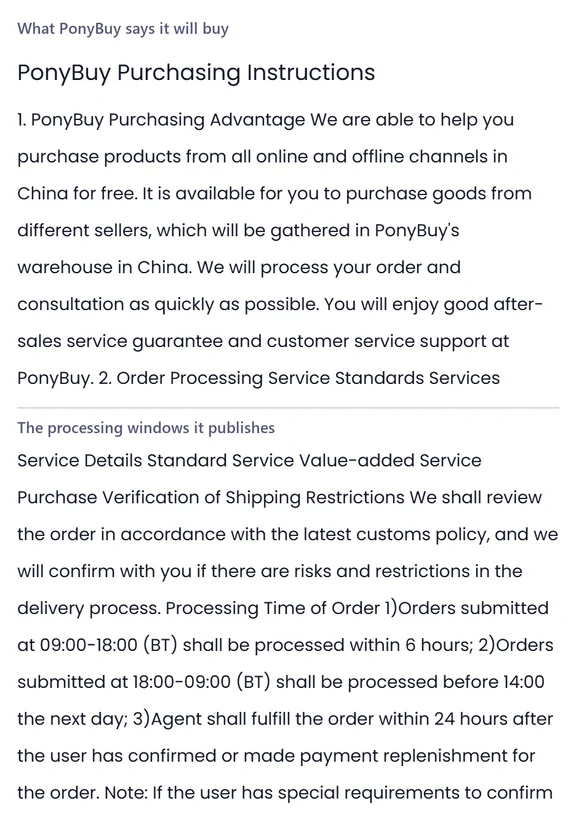
Does it publish a processing window. Does it say what it will refuse to buy. Does it publish a cancellation rule with a deadline attached. Does it state what its inspection does not cover. Does it name the carriers it works with. And does it ever tell you when not to use it.
PonyBuy answers five of those six in writing, and the one page in the picture carries three of them at once. That is the standard worth holding anyone to, because a published commitment is the only kind you can point at afterwards. An agent that answers none of the six is not necessarily worse. It is just one you would be choosing on feel. If you want to see how specific this can get, the purchasing instructions are the page to open, and the statuses page shows what happens when two published answers disagree with each other.
Choosing a seller when the agent will not vouch for one
No agent vets sellers for you, and PonyBuy is franker about this than most. Its own shopping guidance says that some Chinese sites have low credibility, that it cannot ensure the quality of what they send, and that judging them is your job. Elsewhere it repeats the point in legal language: the service covers selected platforms, and quality problems or infringement claims arising from those third party sellers are not its responsibility.
So the seller is the one decision in this whole process that nobody else touches. Two published details help. The first is that a stock figure on a listing is not a fact. PonyBuy says some sellers rarely update their store information and that what counts is the answer a purchaser gets after contacting the seller directly, which is why an order can turn into an out of stock notice hours after you paid for something the page said was available.
The second is about money rather than trust. Buying several items from one seller and checking them out together means the Chinese domestic delivery is charged once rather than once per order. That single rule is the reason experienced buyers cluster their finds by seller before generating anything. It has a limit: if the combined order is heavy enough to push the domestic parcel overweight, a purchaser comes back and asks you to clear the difference.
Reliable sellers, in practice, are the ones you have used before. Until then the useful proxies are the ordinary ones, a store with history, a listing with real photographs rather than borrowed ones, and a price that is not conspicuously below every other listing of the same thing.
How to judge a listing before you hand over the link
Deciding what to buy through an agent is not the same as deciding what to buy. Six things about a listing change what the whole journey costs, and all six are visible before you generate anything.
| What to look at | Why it matters on this route | What skipping it costs |
|---|---|---|
| Whether the stock figure is real | Displayed stock is unverified until a purchaser asks the seller | An order that becomes a refund, and a restart at a new price |
| Whether the sizing is a Chinese chart | Chinese sizing runs smaller than most Western charts | Paying to fly something you will not wear |
| Whether the seller delivery is free | Domestic delivery is part of the first payment when it is not | A balance request on an order you thought was settled |
| Whether several items share one seller | One seller, checked out together, is charged domestic delivery once | Paying the domestic leg two or three times over |
| How heavy and how bulky it is | Weight and volume set the second payment, not the first | A flight that costs more than the contents |
| Whether it can legally leave and arrive | Restricted goods get marked, and the route list narrows | A box that cannot be submitted, or one that is seized |
The first payment is easy to estimate and the second one is where people are caught out. Running a shipping estimate before generating the order is free, and it is the only step here that changes a decision rather than confirming one.
Four questions worth asking before you commit
The rest of the recurring questions, and the vocabulary these pages use, are on the questions page.
Every agent says the same four things. How do I tell them apart?
Ignore the pitch and read the published rules. Most of what an agent advertises describes steps nobody controls: a Chinese courier, a third party airline, a customs officer. What varies is what the agent commits to in writing. A processing window, a free storage length, a stated inspection scope, a named set of carriers, and a cancellation rule are all things you can hold someone to later.
Does using an agent mean the goods are checked properly?
It means the outside of them is looked at. PonyBuy describes free quality inspection as part of the service and separately publishes what that inspection excludes, including colour difference, finishing faults and whether an electronic item works. Any agent offering free inspection is offering roughly that. Treat the exclusions as the real specification.
Is there a case where I should not use an agent at all?
Yes, and it is a common one. If you already hold a Chinese platform account and a way to pay sellers, you can buy directly and use the forwarding service for the flight alone, which removes the purchasing side of the bill entirely. PonyBuy publishes both totals side by side and does not pretend the agent route is always the cheaper one.
Whose fault is it if the seller turns out to be a fraud?
Yours, under the published terms, and PonyBuy says so in more than one place. It provides the shopping agent service for selected platforms and states that it is not responsible for quality issues or infringement arising from those third party sellers. It also says outright that some Chinese sites have low credibility and that it cannot guarantee what they send.